Cybersecurity · Systems Programming · Beginner Guide
Why Memory Safety Is a U.S. Cybersecurity Priority—and Why Rust Matters
A ground-up explanation of the hidden memory bugs behind decades of security failures, how Rust blocks many of them before software runs, and what government guidance actually says.

1. First, what is the U.S. government actually saying?
The headline “the U.S. wants developers to stop using C and C++” is catchy, but incomplete. The more accurate story is that several parts of the U.S. security ecosystem have repeatedly encouraged software manufacturers to adopt memory-safe languages where practical.
NSA
Recommended memory-safe languages when possible, backed by compiler, toolchain, and operating-system hardening for code that remains unsafe.
CISA + partners
Asked manufacturers to publish practical memory-safety roadmaps and prioritize high-risk components instead of pretending a full rewrite is easy.
White House ONCD
Framed memory-safe languages as a secure software building block and highlighted hybrid migration for large existing codebases.
DARPA
Created TRACTOR, a research program aiming to automate high-quality translation of legacy C code into Rust.
What it is
Strong government guidance, procurement pressure, research investment, and a Secure by Design direction.
What it is not
A universal law that bans C/C++, mandates Rust everywhere, or claims Rust solves every security problem.
Why the urgency? NSA’s public guidance cites Microsoft and Google findings that memory-safety problems accounted for roughly 70% of vulnerabilities in their large native-code products. The exact percentage varies by codebase, but the strategic lesson is stable: if one root cause repeatedly creates many vulnerability types, eliminate the root cause rather than endlessly patching symptoms.
2. Before Rust: what does “memory” mean?
Imagine a computer’s working memory, or RAM, as a giant wall of tiny numbered lockers. Each locker holds a small piece of information. Its number is an address. When a program creates a name, image, list, or network message, it asks for lockers, writes data into them, reads it later, and eventually gives them back.
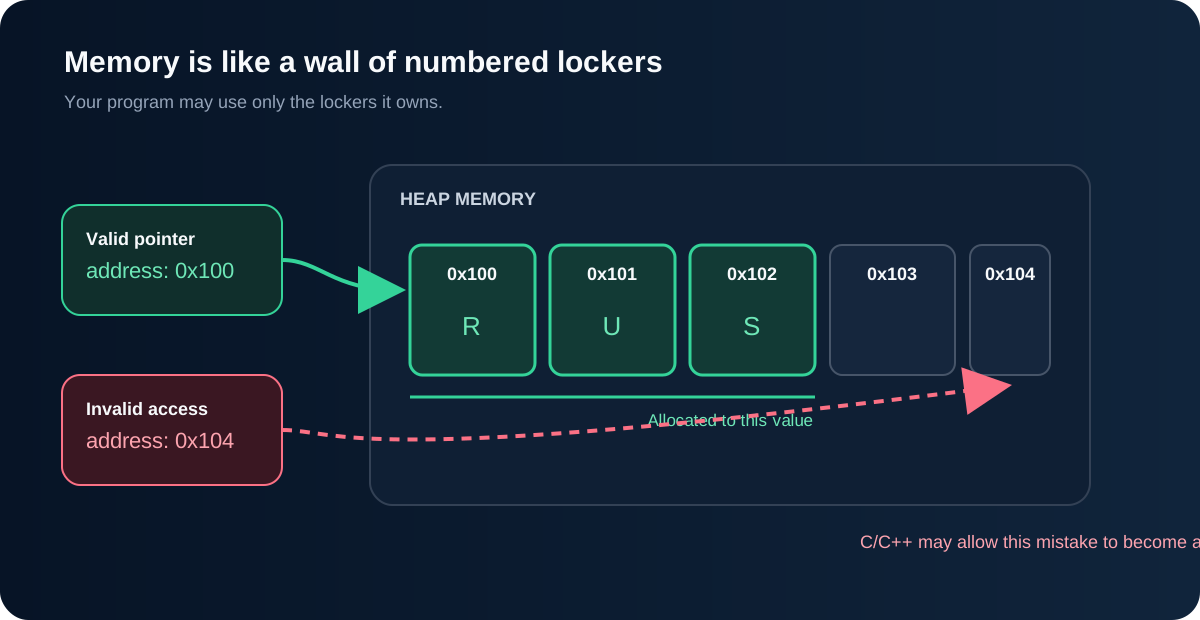
A pointer is simply a value that stores an address—like a note saying “the data you want is in locker 0x100.” Pointers are powerful because they let system software work directly with hardware and memory. They are dangerous because a wrong, stale, or attacker-controlled address can make the program read secrets, corrupt data, crash, or run malicious instructions.
Stack
Fast, orderly storage for local values whose size and lifetime are easy to manage. Think of plates stacked and removed from the top.
Heap
Flexible storage for values that may be large or live for an unpredictable time. The program allocates space and later releases it.
C and C++ give programmers very direct control over these operations. That control helps build operating systems, browsers, databases, games, drivers, and embedded software. But the compiler traditionally trusts the programmer to follow the rules. A small mistake can compile successfully and remain hidden until a rare production situation—or an attacker—triggers it.
3. Six memory bugs in plain English
These examples use simplified C-like code to make each failure visible. They are intentionally small teaching examples—not complete programs—and omit unrelated setup so you can focus on the memory mistake itself.
Failure 1Buffer overflow
A program writes more data into a fixed-size buffer than the buffer can hold. The result may be a crash or corrupted data. In serious cases, carefully shaped input can alter program control flow and contribute to arbitrary code execution.
Expand for example and detailed explanationHide detailed explanation
Buffer overflow
A program writes more data into a fixed-size buffer than the buffer can hold. The result may be a crash or corrupted data. In serious cases, carefully shaped input can alter program control flow and contribute to arbitrary code execution.
Expand for example and detailed explanationHide detailed explanation
Everyday analogy
Imagine filling a six-slot egg carton with ten eggs. The extra eggs do not disappear—they smash into whatever is beside the carton.
Simplified example
char username[8];
copy_without_checking(username, user_input);
// If user_input is longer than 7 characters plus the terminator,
// bytes may be written beyond username.
What happens step by step
- 1The program reserves eight bytes for a username.
- 2It copies input without first checking the input length.
- 3A longer value reaches byte nine and continues into neighboring memory.
- 4That neighboring memory might contain another variable, bookkeeping data, or control information.
Why it is a security risk
The result may be a crash or corrupted data. In serious cases, carefully shaped input can alter program control flow and contribute to arbitrary code execution.
What safe Rust changes
Safe Rust slices and strings know their length. Indexing outside that length is rejected when provable at compile time or stops safely with a panic at runtime instead of silently overwriting adjacent memory. APIs such as copy_from_slice also require compatible lengths.
Failure 2Use-after-free
A program accesses heap memory after that memory has already been released. The program can crash, expose newly stored information, or corrupt a different object. Attackers may try to influence what replaces the freed object so the stale pointer operates on attacker-controlled data.
Expand for example and detailed explanationHide detailed explanation
Use-after-free
A program accesses heap memory after that memory has already been released. The program can crash, expose newly stored information, or corrupt a different object. Attackers may try to influence what replaces the freed object so the stale pointer operates on attacker-controlled data.
Expand for example and detailed explanationHide detailed explanation
Everyday analogy
It is like keeping a hotel-room key after checkout. The room may now belong to someone else, so opening it exposes or changes another guest’s belongings.
Simplified example
Profile *profile = create_profile();
destroy_profile(profile);
print_name(profile); // profile points to memory that was released
What happens step by step
- 1The program allocates memory for a profile and stores its address in a pointer.
- 2The profile is destroyed and its memory becomes available for reuse.
- 3The pointer still contains the old address, although it no longer owns valid profile data.
- 4A later read or write uses whatever now happens to occupy that location.
Why it is a security risk
The program can crash, expose newly stored information, or corrupt a different object. Attackers may try to influence what replaces the freed object so the stale pointer operates on attacker-controlled data.
What safe Rust changes
When an owning value is dropped or moved, safe Rust prevents later use of the old owner. References are also forbidden from outliving the value they borrow, so the stale-access state is rejected by the borrow checker.
Failure 3Double-free
A program releases the same allocation more than once. Common outcomes include an immediate safety check failure or crash. In vulnerable allocators, corrupted bookkeeping may enable later writes to unintended addresses.
Expand for example and detailed explanationHide detailed explanation
Double-free
A program releases the same allocation more than once. Common outcomes include an immediate safety check failure or crash. In vulnerable allocators, corrupted bookkeeping may enable later writes to unintended addresses.
Expand for example and detailed explanationHide detailed explanation
Everyday analogy
Imagine returning the same numbered theater ticket twice. The booking system may assign that one seat to two different people because its record of availability is now inconsistent.
Simplified example
char *message = allocate_message();
free(message);
// A second cleanup path mistakenly handles the same pointer.
free(message);
What happens step by step
- 1Memory is allocated and the allocator records that the block is in use.
- 2The first free correctly returns the block to the allocator.
- 3A second free falsely reports that the already-available block was returned again.
- 4The allocator’s internal bookkeeping can become inconsistent, especially when that block has already been reused.
Why it is a security risk
Common outcomes include an immediate safety check failure or crash. In vulnerable allocators, corrupted bookkeeping may enable later writes to unintended addresses.
What safe Rust changes
A value has one owner, and Rust automatically drops it once when that owner leaves scope. Moving ownership invalidates the former owner, preventing two ordinary safe values from independently freeing the same allocation.
Failure 4Dangling pointer
A pointer or reference remains after the value it referred to no longer exists. Reading through the pointer can reveal unrelated stack data or produce unpredictable results; writing through it can corrupt later work performed in the same memory.
Expand for example and detailed explanationHide detailed explanation
Dangling pointer
A pointer or reference remains after the value it referred to no longer exists. Reading through the pointer can reveal unrelated stack data or produce unpredictable results; writing through it can corrupt later work performed in the same memory.
Expand for example and detailed explanationHide detailed explanation
Everyday analogy
It is an address card for a shop that has permanently closed. The card still looks valid, but a different business—or nothing at all—may now be at that location.
Simplified example
const char *get_label() {
    char label[16] = "temporary";
    return label; // label disappears when the function returns
}
What happens step by step
- 1The function creates a local value on its stack frame.
- 2It returns the address of that local value rather than returning an owned copy.
- 3Returning from the function ends the value’s lifetime and reclaims its stack space.
- 4The caller receives an address whose contents may already have changed.
Why it is a security risk
Reading through the pointer can reveal unrelated stack data or produce unpredictable results; writing through it can corrupt later work performed in the same memory.
What safe Rust changes
Rust tracks the relationship between a reference and its source. Returning a reference to a local value is a compile-time error because the reference would outlive the value. The function must return an owned value instead.
Failure 5Out-of-bounds access
A program reads or writes using an index that falls outside an array, slice, or object. An out-of-bounds read can disclose process data, as Heartbleed famously demonstrated. An out-of-bounds write can corrupt state, crash a service, or help redirect execution.
Expand for example and detailed explanationHide detailed explanation
Out-of-bounds access
A program reads or writes using an index that falls outside an array, slice, or object. An out-of-bounds read can disclose process data, as Heartbleed famously demonstrated. An out-of-bounds write can corrupt state, crash a service, or help redirect execution.
Expand for example and detailed explanationHide detailed explanation
Everyday analogy
A bookshelf has shelves numbered 0 through 4, but someone asks for shelf 7. Without a boundary check, they may reach into the neighboring cabinet instead.
Simplified example
int scores[3] = {10, 20, 30};
int requested_index = 5;
int score = scores[requested_index]; // valid indexes are only 0, 1, 2
What happens step by step
- 1The array contains three elements, so its final valid index is two.
- 2An index—possibly derived from external input—is used without validation.
- 3Address arithmetic points beyond the array’s assigned region.
- 4The program reads unrelated bytes or overwrites data belonging to something else.
Why it is a security risk
An out-of-bounds read can disclose process data, as Heartbleed famously demonstrated. An out-of-bounds write can corrupt state, crash a service, or help redirect execution.
What safe Rust changes
Safe indexing checks the boundary. An invalid direct index causes a controlled panic, while slice.get(index) returns None so the program can handle missing data without reading arbitrary memory.
Failure 6Data race
Two threads access the same memory concurrently, at least one writes, and their access is not synchronized. The visible symptom may be a lost update, corrupted object, intermittent crash, or authorization decision based on inconsistent state. These bugs are notoriously difficult to reproduce.
Expand for example and detailed explanationHide detailed explanation
Data race
Two threads access the same memory concurrently, at least one writes, and their access is not synchronized. The visible symptom may be a lost update, corrupted object, intermittent crash, or authorization decision based on inconsistent state. These bugs are notoriously difficult to reproduce.
Expand for example and detailed explanationHide detailed explanation
Everyday analogy
Two cashiers update the same paper balance at once. Both read ₹1,000, one adds ₹100 and the other subtracts ₹50, but the last writer may erase the other cashier’s update.
Simplified example
// Shared by two threads without a lock:
int balance = 1000;

thread_a: balance = balance + 100;
thread_b: balance = balance - 50;
What happens step by step
- 1Each update is really a sequence: read the value, calculate a result, then write it back.
- 2The scheduler may interleave those individual operations in many orders.
- 3Both threads can read the same starting value before either writes.
- 4The final result becomes timing-dependent, and in C/C++ a data race is undefined behavior.
Why it is a security risk
The visible symptom may be a lost update, corrupted object, intermittent crash, or authorization decision based on inconsistent state. These bugs are notoriously difficult to reproduce.
What safe Rust changes
Safe Rust does not allow ordinary mutable references to be shared across threads. Thread-safe types such as Mutex and atomics make synchronization explicit, and the Send and Sync traits prevent incompatible values from crossing thread boundaries.
4. Rust changes when mistakes are found
Rust does not make physical memory different. It changes the programming model. The compiler tracks who owns a value, who is temporarily using it, whether it may be changed, and how long references remain valid. If it cannot prove the safe rules are followed, compilation stops.
C/C++ pattern
Write code
The program may compile even when a dangerous pointer state is possible.
Runtime discovery
Run software
A test, user, or attacker eventually reaches the faulty path.
Rust pattern
Compile first
The compiler rejects many invalid ownership, lifetime, and concurrency states before deployment.
This is Rust’s central bargain: the developer spends more effort expressing valid relationships to the compiler, and in return the compiler prevents broad bug classes on every build. The phrase “if it compiles, it is correct” is still an exaggeration—logic can be wrong—but many memory states that would be dangerous in C or C++ cannot be represented in safe Rust.
5. Ownership, moves, and borrowing
Ownership: one accountable variable
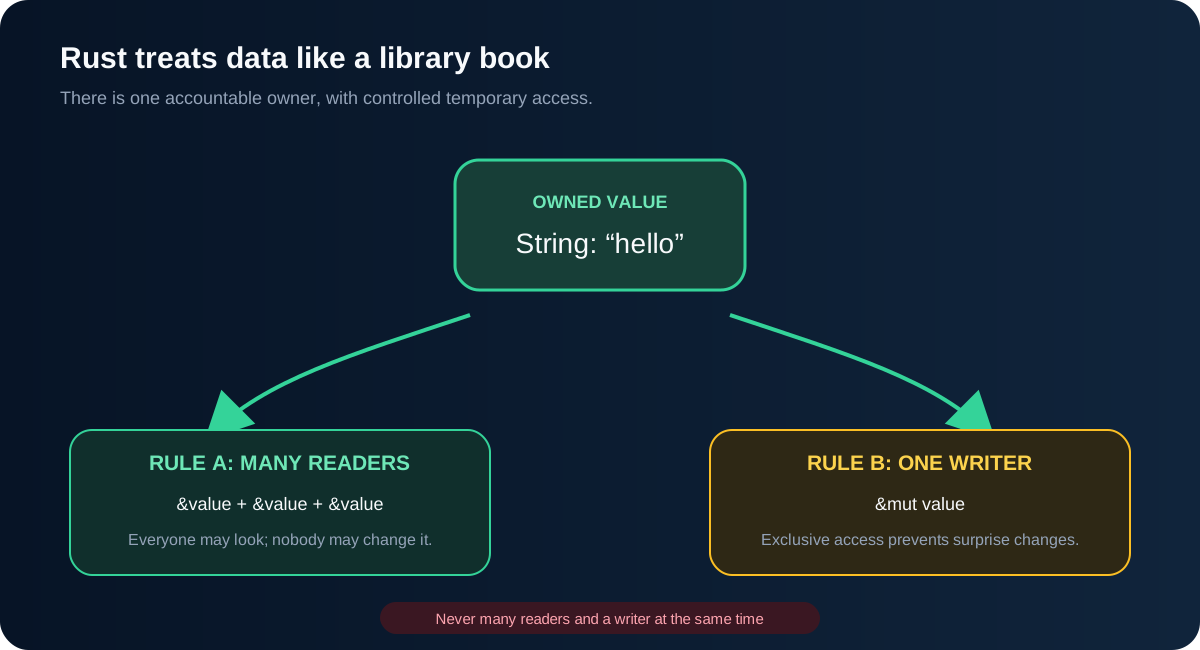
Every Rust value has an owner. When the owner leaves scope, Rust automatically cleans up the value. No garbage collector must pause later to search for unused values, and the programmer does not manually call free for ordinary safe code.
fn main() {
    let message = String::from("hello"); // message owns heap data
    println!("{message}");
} // message leaves scope; Rust frees its data exactly once
Move semantics: ownership can transfer
Assigning a heap-owning value usually moves ownership. The old variable becomes unusable, preventing two variables from both believing they must free the same memory.
let first = String::from("secure");
let second = first;          // ownership moves to second

println!("{second}");        // valid
// println!("{first}");      // compile error: value was moved
Borrowing: temporary access without taking ownership
A reference such as &String borrows a value. The function may inspect it, but does not own or destroy it. Rust permits either many immutable references or one mutable reference at a time—not both. That simple-sounding rule prevents mutation while someone else is reading and is the foundation of Rust’s compile-time data-race protection.
fn length(text: &String) -> usize { // borrow, do not own
    text.len()
}

let name = String::from("Rust");
let size = length(&name);
println!("{name} has {size} bytes"); // name still owns the value
6. Lifetimes and the borrow checker
A lifetime describes the period during which a reference is valid. Most lifetimes are inferred; developers write annotations mainly when a function connects multiple input and output references. A lifetime does not keep data alive. It helps the compiler verify that a reference cannot outlive the data it points to.
fn broken_reference() -> &String {
    let local = String::from("temporary");
    &local
} // rejected: local is destroyed here, so returning &local would dangle
The borrow checker is the part of the Rust compiler that enforces these ownership, borrowing, and lifetime rules. Beginners often experience its errors as friction. A better mental model is a strict reviewer available on every compile: it refuses to approve a reference relationship it cannot prove safe.
What about threads?
The same rules extend into concurrency. Rust types describe whether data can safely move between threads or be shared across them. Unsafe sharing patterns are rejected unless protected through tools such as mutexes or atomic types. Rust cannot prevent deadlocks or every concurrency logic bug, but safe Rust prevents data races by construction.
7. If Rust is safe, why does unsafe exist?
Systems software sometimes must dereference a raw pointer, communicate with hardware, call a C library, or implement a low-level abstraction the compiler cannot verify. An unsafe block allows a small set of extra operations. It does not turn off the entire language, and it does not mean “this code is definitely wrong.” It means “the programmer must manually uphold specific safety contracts here.”
unsafe {
    // Raw pointer operations are allowed in this explicit boundary.
    // The author must prove the pointer is valid and correctly aligned.
    println!("{}", *raw_pointer);
}8. Why Rust instead of Java, Go, Python, or C#?
Those languages are also memory-safe for ordinary code, and official guidance names several of them. Rust is not the universal winner. The correct choice depends on the product. Rust stands out when a team needs memory safety and native performance, predictable latency, a small runtime, direct hardware access, or operation without a mandatory garbage collector.
| Language | Memory model | GC | Native performance | Best fit |
|---|---|---|---|---|
| C / C++ | Manual | None required | Excellent | Maximum control; memory mistakes remain possible |
| Rust | Ownership checked at compile time | None required | Excellent | Systems control with safe defaults |
| Java / C# | Garbage collected | Yes | Good | Productivity, mature runtimes, managed memory |
| Go | Garbage collected | Yes | Good | Simple concurrency and network services |
| Python | Managed runtime | Yes / reference counting | Usually lower | Fast development and a broad ecosystem |
Garbage collection is an excellent engineering trade-off for many services and applications. But a GC runtime may be unsuitable for tiny embedded devices, operating-system kernels, hard latency targets, or libraries that must integrate without imposing a runtime on their host. Rust fills that systems-level gap.
9. Rust, HTTPS, TLS, and Heartbleed
Rust does not replace HTTPS. HTTPS is HTTP carried inside TLS, which encrypts data in transit, authenticates the server, and protects message integrity. Rust is a language in which a browser, server, networking stack, cryptographic library, or TLS implementation may be written.
Browser
Creates HTTPS request
TLS library
Encrypts and verifies
Server
Processes application data
Heartbleed: a bounds-checking lesson
Heartbleed was disclosed in OpenSSL in 2014. A client could claim that a small heartbeat message was much larger than it really was. The vulnerable C implementation copied back the claimed number of bytes without adequately validating that the input buffer contained them. The response could therefore include nearby process memory—potentially exposing secrets.
Heartbleed was not a failure of encryption mathematics. It was a memory-bounds failure inside widely used TLS software. A memory-safe design makes this class of out-of-bounds read substantially harder because normal indexed or sliced access is bounds-checked. Logic still matters: safe code could intentionally return the wrong data, but it cannot casually read arbitrary adjacent memory through an unchecked safe slice.
10. What Rust does not prevent
Memory safety is one layer of security, not a synonym for secure software.
Rust narrows the attack surface by eliminating or reducing a major family of defects. Teams still need threat modeling, secure architecture, input validation, access control, dependency management, testing, monitoring, incident response, and skilled review.
11. How a real organization should migrate
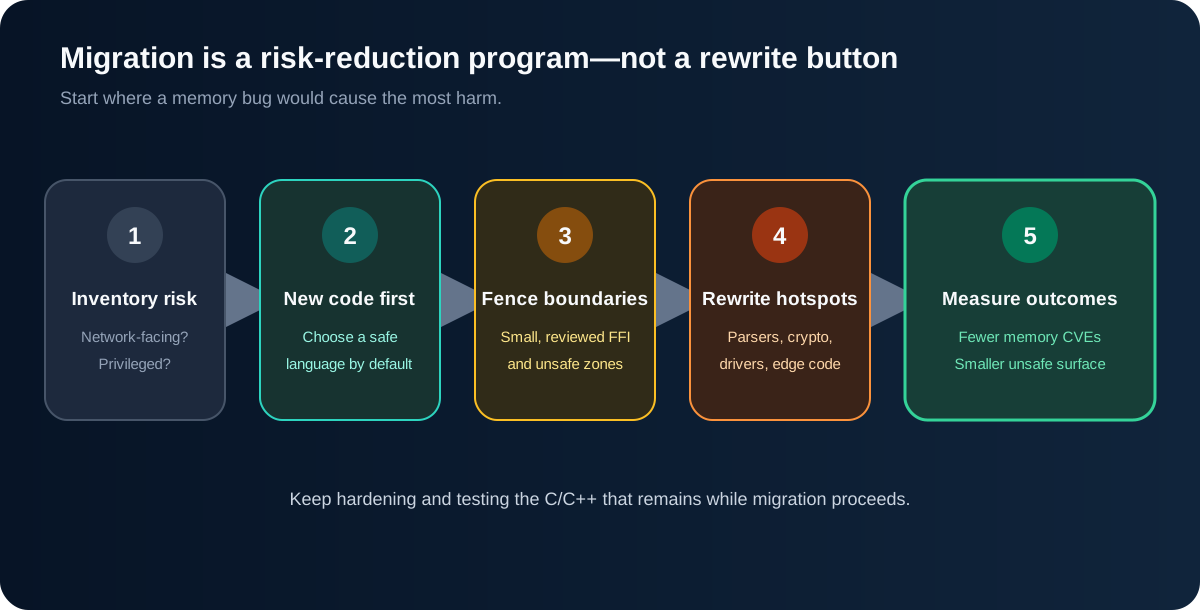
Rewriting a mature C or C++ product all at once is expensive and risky. Rewrites can introduce new logic bugs, break compatibility, and consume years. Official guidance therefore emphasizes roadmaps and prioritization.
- 1
Inventory and rank risk
Find network-facing parsers, code running with high privileges, cryptographic components, and modules with a history of memory CVEs.
- 2
Make safe languages the default for suitable new code
Stop growing the unsafe surface. Choose Rust where systems constraints justify it, and a managed memory-safe language where it is the better fit.
- 3
Create narrow interoperability boundaries
Rust can call C and C can call Rust through a foreign function interface (FFI). Treat every boundary as unsafe: validate lengths, ownership, nullability, and error behavior.
- 4
Replace high-value components incrementally
A parser or networking module can be rewritten while the rest of the product remains in C/C++. Ship, observe, and expand based on evidence.
- 5
Measure outcomes
Track the amount of new memory-unsafe code, unsafe Rust surface, memory-related vulnerabilities, remediation time, performance, and developer readiness.
Where DARPA TRACTOR fits
DARPA’s TRACTOR program researches automated translation of legacy C into idiomatic, safe Rust. That is a hard problem: a literal syntax conversion may reproduce C’s pointer assumptions inside large unsafe blocks, which changes the language but not the security outcome. The stated ambition is closer to the quality a skilled Rust developer would produce. It is research—not a magic production button today—but it shows why automated migration matters at national scale.
12. Interview-ready answers
Is the U.S. banning C and C++?+
No. U.S. agencies are strongly encouraging memory-safe roadmaps and safer defaults, especially for new and security-critical code. Migration is expected to be prioritized and gradual.
Why is Rust special?+
It provides memory safety and thread safety through compile-time ownership and borrowing checks while retaining native performance, low-level control, and no mandatory garbage collector.
What is ownership?+
Each value has one owner responsible for its lifetime. Ownership may move, and when the owner leaves scope the value is cleaned up exactly once.
What is borrowing?+
Borrowing provides temporary access through references without transferring ownership. Rust allows many readers or one writer at a time.
What are lifetimes?+
They describe relationships between how long references are valid, allowing the compiler to reject dangling references. They usually are inferred.
Does Rust make software secure?+
No. It prevents many memory-safety and data-race bugs in safe code, but not injection, broken authorization, flawed cryptography, dependency risk, or business-logic errors.
Why not rewrite everything?+
Large rewrites introduce cost and risk. A better plan uses safe languages for new code, prioritizes high-risk legacy components, isolates unsafe boundaries, and measures results.
How does Rust relate to HTTPS?+
Rust does not replace HTTPS. It can make implementations of TLS, networking, and cryptographic infrastructure less exposed to memory-corruption vulnerabilities.
Recommended learning order
Primary sources and further reading
Policy claims in this article are grounded in official government guidance. These links are the best place to verify the wording and go deeper.
- White House ONCD — Back to the Building Blocks (2024)
- NSA — Software Memory Safety guidance
- CISA and partners — The Case for Memory Safe Roadmaps
- DARPA — TRACTOR: Translating All C to Rust
- OpenSSL — Heartbleed security advisory
- The Rust Book — Understanding ownership
Note: Government recommendations and program descriptions can evolve. This article distinguishes voluntary guidance and research programs from legal mandates and was last reviewed on August 31, 2026.
Comments
Share feedback or questions about this case study.
No comments yet.